From a question our founders could not ignore to a permanent resource we are determined to build.
A planned GCA program in Illinois. Fundraising is underway; the rescue & sanctuary is not yet open.
WHY WE ARE BUILDING THIS
A promise taking shape.
Long before there was a sanctuary proposal, there was a question that stayed with our founders: when hundreds of chinchillas need help at once, where can they go?
The Valley View and Moulton cases made that question impossible to ignore. They showed our founders why chinchillas need lasting, species-specific support: people who understand their care, places prepared to receive them, and a community that stays involved after the headlines fade.
2014 · VALLEY VIEW
Hundreds of lives. One urgent need.
San Diego Humane Society took in more than 400 chinchillas from Valley View. The scale of that response brought into focus the housing, veterinary care and placement work that a large chinchilla rescue demands.
An administrative law judge permanently revoked the dealer license of Moulton Chinchilla Ranch’s owner following serious animal-welfare violations. For GCA’s future founders, the case reinforced the need for both prevention through education and a prepared response when animals need help.
When we established Global Chinchilla Alliance in 2024, education, welfare and rescue were part of our purpose from the beginning. We have been working toward this vision by bringing together chinchilla experience, developing educational resources and building the relationships and plans a dedicated center will need.
NOW · THE R & R CASE
From “one day” to “let’s make this happen.”
The R & R case in Ohio has brought renewed urgency to that longstanding goal. For GCA, it is the call to move from planning toward implementation: raising the funds, bringing people together and preparing the facilities that can serve chinchillas for years to come.
SEPTEMBER 19, 2026 · A TANGIBLE COMMITMENT
A donor helped open the door.
$20,000Earnest money provided by an anonymous donor
$575,000Negotiated property purchase price
On September 19, an anonymous donor put forward $20,000 in earnest money and negotiated an agreement with the property owner to hold the Illinois property at the agreed purchase price of $575,000 for 90 days while GCA pursued donations toward its acquisition.
The intent was to give the Ohio chinchillas a safe place for a minimum 90-day quarantine, veterinary care and rehabilitation. The deposit secured an opportunity to move forward; GCA still needs donations to complete the purchase and establish the facilities.
Whether or not the Ohio herd ultimately comes into GCA’s care, the need for this work remains. As more people welcome chinchillas into their homes, GCA sees a growing need for specialized rescue support, responsible-care education and lifetime sanctuary for animals who need it.
CENTRAL ILLINOIS
A place for every part of the mission.
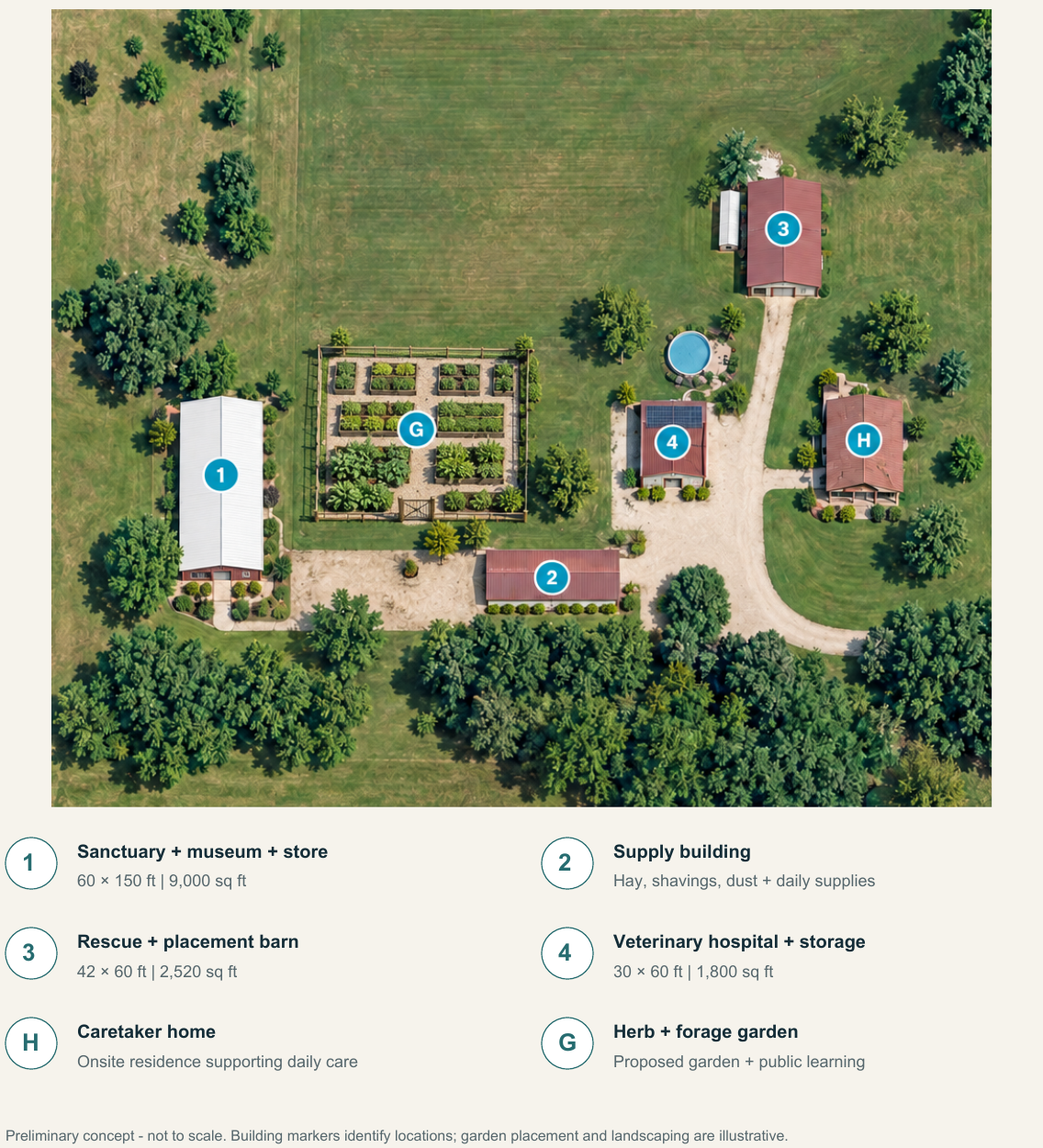
Proposed campus layout and building key. Concept only; not to scale.
Building 3: planned rescue capacity of up to 1,200 chinchillas.
Whatever happens with the Ohio herd, this mission moves forward.
Our commitment to building GCA Chinchilla Rescue & Sanctuary does not depend on receiving animals from any one case. We are working toward lifetime sanctuary care, a separate rescue and rehoming program, and a place for the public to discover chinchilla history and responsible care.
The rescue & sanctuary is not yet open. The next step is to turn this developed vision into a funded, functioning home, and we are inviting our community to help make it happen.
Established in 2024, GCA brings together people who care about chinchillas through education, welfare advocacy and a shared commitment to better care. The rescue and sanctuary puts that mission into a physical place: a home for animals, a resource for owners and a center for learning.
This is a GCA program, with contributions handled through the organization. GCA is a 501(c)(3) nonprofit, EIN 99-2008449.
Once pursued for their pelts. Now cherished as companions. Always an animal with a life of their own.
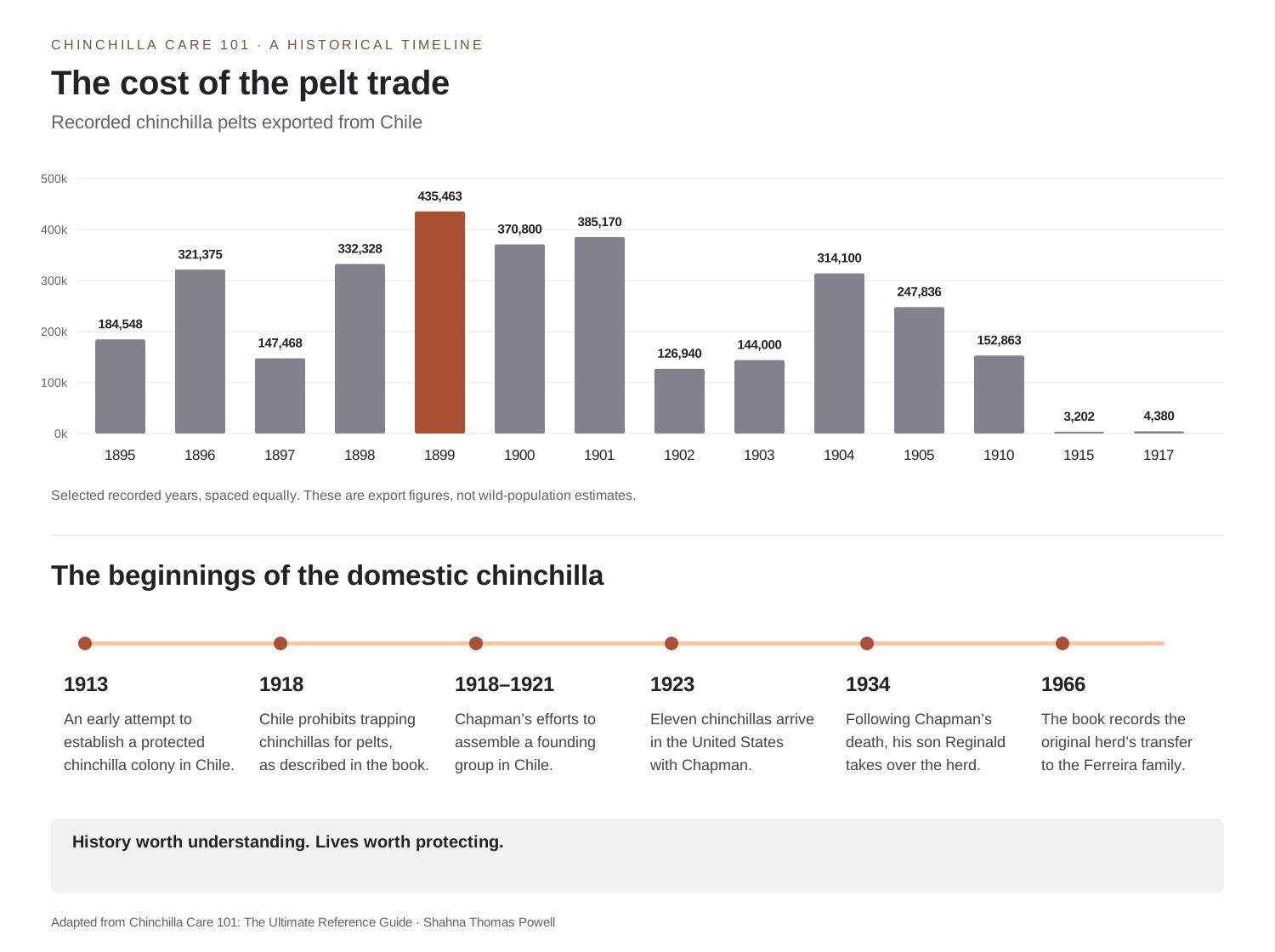
Commercial hunting for fur devastated wild chinchilla populations. The arrival of a small founding group in California in 1923 helped establish the U.S. domestic fur-farming industry. Today, GCA’s vision is a place devoted to chinchillas themselves: their welfare, their history and the qualities that make them unique.
Shahna Thomas Powell’sChinchilla Care 101: The Ultimate Reference Guide explores that history. This timeline brings together the historical export figures and milestones from her book. The export figures show the scale of the pelt trade, not a count of the wild population.
Supporting rescue and raising standards for breeding are part of the same commitment: the animal comes first.
Both wild chinchilla species are endangered. At the same time, domestic chinchillas already live with people around the world. That history cannot be undone. GCA believes our responsibility is to improve the lives and long-term health of the animals in human care, while respecting their wild counterparts.
GCA aims to lift up breeders who put welfare, health and responsible stewardship ahead of production or profit. We want the public to be able to distinguish that commitment from indiscriminate breeding and sales without lasting responsibility for the animals.
Welfare before volume
Thoughtful breeding decisions, appropriate housing, veterinary care and honest records should take priority over producing more animals.
Responsibility beyond a sale
Education, careful placement and ongoing support help owners understand the lifelong commitment a chinchilla requires.
Respect for domestic lines
Preserving documented lineage, health and genetic diversity in domestic populations matters. Domestic breeding does not, by itself, conserve endangered wild populations or their habitat.
Standards people can recognize
GCA’s broader goal is to make welfare-centered practices visible, support education and help the public ask informed questions about where animals come from.
Look at the whole supply chain.
GCA’s concern is a market that rewards volume without ensuring welfare, traceability and lifelong responsibility. Small breeders whose practices demonstrate those values should not be treated as interchangeable with volume-driven suppliers.
Published U.S. import research covering 1999–2013 documented chinchilla imports, including from Canada, and a broader shift toward large-scale overseas rodent breeding for commercial U.S. sales. It does not establish the current share of pet-store chinchillas supplied by foreign farms.
We believe retailers and suppliers, in the United States and abroad, should be accountable for animal care, sourcing and the information given to buyers. Size or country of origin alone does not establish whether a breeder is ethical; practices and outcomes matter.
Our Illinois location has a different role.
The Illinois rescue and sanctuary will not breed chinchillas. Its purpose is rescue, rehabilitation, placement in vetted pet homes, lifetime sanctuary and education. GCA’s broader support for ethical breeders takes place outside that facility.